 Ahmad Affan
Trading
How a Telegram signal copier for MT4/MT5 works, and why latency is not slippage
A signal copier is a pipeline with five hops and a lot of ways to lose money. Here is the architecture I use, and how to measure what a copier really costs you.
By Ahmad AffanUpdated 4 min read

Key takeaways
- A Telegram copier chains five steps: delivery, parsing and filters, queue, local checks and broker execution.
- Latency is time. Slippage is the difference between the expected price and the fill. They are related only when the market moves.
- Published breakdowns put a Telegram-to-MT5 chain at roughly 300 ms to 2.5 s end to end, and most of it sits outside the copier itself.
- Risk controls decide whether a copier is safe: spread filter, stale-signal limit, duplicate checks, lot and daily-loss limits and a kill switch.
- Always test on a demo account first and log post time, order time, fill time and both prices.
- This is engineering information, not financial advice.
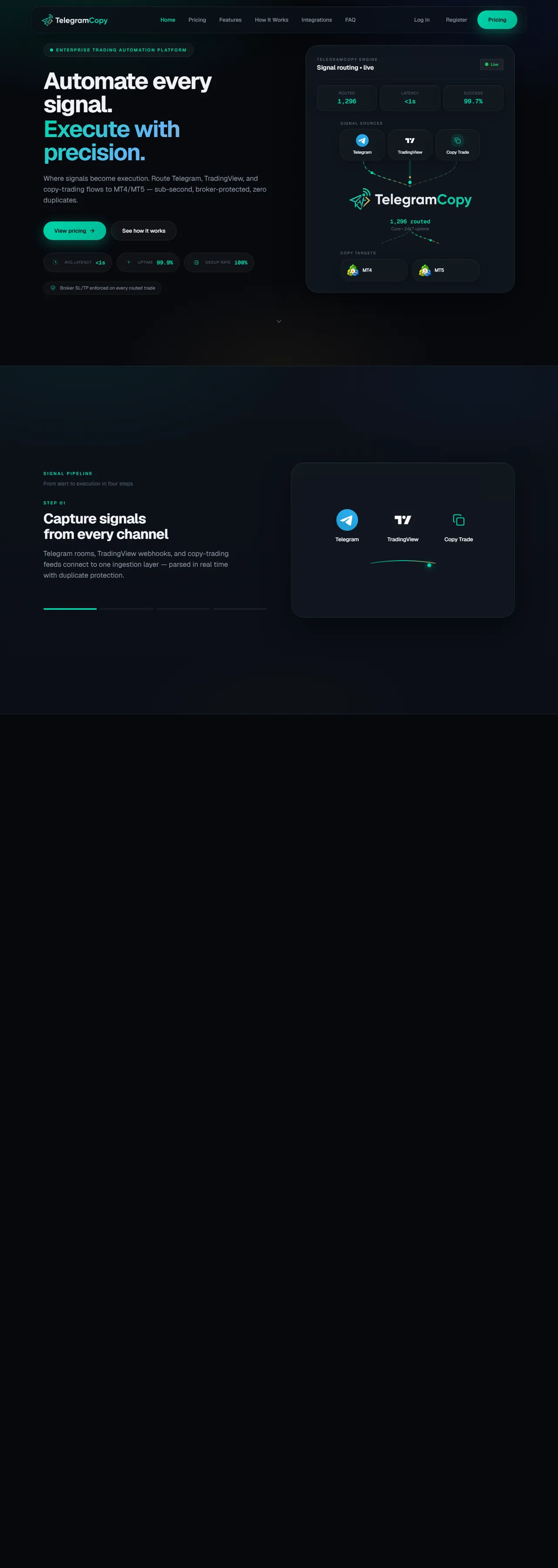
Many trading communities post signals in Telegram: an instrument, a direction, an entry, a stop loss and some targets. A signal copier reads those posts and places the matching trades on your MetaTrader account, so nobody has to watch the chat. It sounds simple. In practice it is a pipeline where each step can fail, and the details decide whether it helps or hurts.
I built this end to end for TelegramCopy: the customer dashboard, the API, the Telegram worker, the MT4/MT5 Expert Advisors and the billing. This guide explains how such a system works and how to judge one. It is engineering information, not financial advice, and trading carries a risk of loss.
The five steps of a Telegram copier
- Delivery. The post is written by a person and delivered by Telegram to the copier.
- Parsing and filters. Free text becomes structured data: symbol, side, entry, stop loss, targets. Duplicate checks and keyword filters run here.
- Queue. The valid signal is placed on a durable queue, so bursts never drop a trade.
- Local checks. Symbol mapping, lot sizing, spread, open-trade limits and trading hours are checked for that account.
- Broker execution. The order is sent and the broker fills it at whatever price is available.
Reading Telegram
A bot cannot read channels it is not in, so serious copiers use the MTProto user API with a Telegram session instead of the Bot API. That session is effectively a login, so it must be stored encrypted and never logged.
Parsing is the hard part
People write signals in dozens of styles: “BUY GOLD 2400-2402”, “XAUUSD long now”, emoji, different order of fields, edits and replies. A good parser is strict. When it is unsure, the right behaviour is to skip and log the message, not to guess.
Two ways to execute
| Expert Advisor on a VPS | Cloud execution API | |
|---|---|---|
| How it works | An EA inside MT4 or MT5 asks your server for pending trades and places them | The system sends orders to a cloud service connected to your account |
| Pros | Runs in the terminal, full control of order logic | No VPS to manage, quick to onboard |
| Cons | Needs a VPS and a healthy terminal, and polling adds delay | Depends on a third party and its supported brokers |
An EA that polls on an interval adds up to that interval to the delay, so the interval is a deliberate trade-off between speed and server load. Having the stop loss and take profit set on the broker side matters too: if the EA stops, the protection remains.
Latency is not slippage
Copier vendors love quoting latency. Latency is only time: how long between a trade appearing on the provider’s side and an order reaching your broker. Slippage is the difference between the price you expected and the price you got. In a quiet, liquid market a longer delay can cost almost nothing, and in a fast market a very short delay can still cost a lot.
One published breakdown of a Telegram-to-MT5 path lists Telegram delivery at roughly 50 to 300 ms, parsing at 10 to 50 ms, local transfer at a few milliseconds, the broker round trip at 20 to 150 ms and liquidity matching at 50 to 500 ms, for a total of about 300 ms to 2.5 s, worse around major news. Other write-ups point out that the person writing the post and the EA’s polling interval are often the biggest pieces of all.
Risk controls that matter
- Maximum spread filter, because spreads widen around news and a copier will otherwise fire into them.
- Stale-signal limit, so the copier skips a signal that is too old instead of chasing the price.
- Duplicate protection, so edited or reposted messages do not open a second trade.
- Lot sizing and open-trade limits per account.
- Daily loss limit and a kill switch the account owner can use at any time.
- Symbol mapping, because brokers name instruments differently.
- Heartbeats and alerts, so you know when the EA or worker goes quiet.
Is a Telegram copier even the right tool?
If your provider also trades on MetaTrader, the platform’s own Signals service copies trades directly between accounts, including across brokers, with a protocol designed to reduce delays. A Telegram copier makes sense when the signals only exist as chat posts, or when you want custom filters, plans and licensing around them.
Building a copier as a product
If you plan to sell access, the engineering around the copier matters as much as the copier. You need subscriptions with webhooks as the source of truth, plan limits enforced on the server, licence checks in the EA, an admin panel and monitoring. That is the part I enjoy most, and it is where many first versions fall short.
To discuss a signal copier, an Expert Advisor or a licensing system, see my trading automation service or get in touch.
Sources
Checked on 28 October 2026. Prices and versions change, so confirm with the vendor before you commit.
Frequently asked questions
It reads signal posts from Telegram, parses them into structured trades, checks them against your risk rules, queues them and sends orders to your MT4 or MT5 account through an Expert Advisor or a cloud execution API.
Latency is the time between the provider’s trade or post and your order. Slippage is the price difference between what you expected and what you got. Delay only turns into slippage when the market moves in that time.
An Expert Advisor runs inside your terminal and gives full order control but needs a VPS. A cloud copier is easier to set up but depends on a third party. The right choice depends on your brokers and how much you want to manage.
No. Brokers differ in spreads, execution and liquidity, so fills can differ. Use spread and stale-signal filters, test on demo first and expect some difference.

Telegram Mini App or bot? How to choose what to build in 2026
Bots are conversations. Mini Apps are full web apps inside Telegram. Most serious products use both, and this guide shows where each one belongs.
Read the guide
Stripe subscription billing for SaaS: webhooks, plan limits and what goes wrong
Taking the first payment is easy. Keeping access correct when cards fail, plans change and events arrive out of order is the real work.
Read the guide